


TRY OUR GROWTH SCANNER


Venture Capital Benchmark Q2 2026
US, Europe, and Latin America
VC Activity
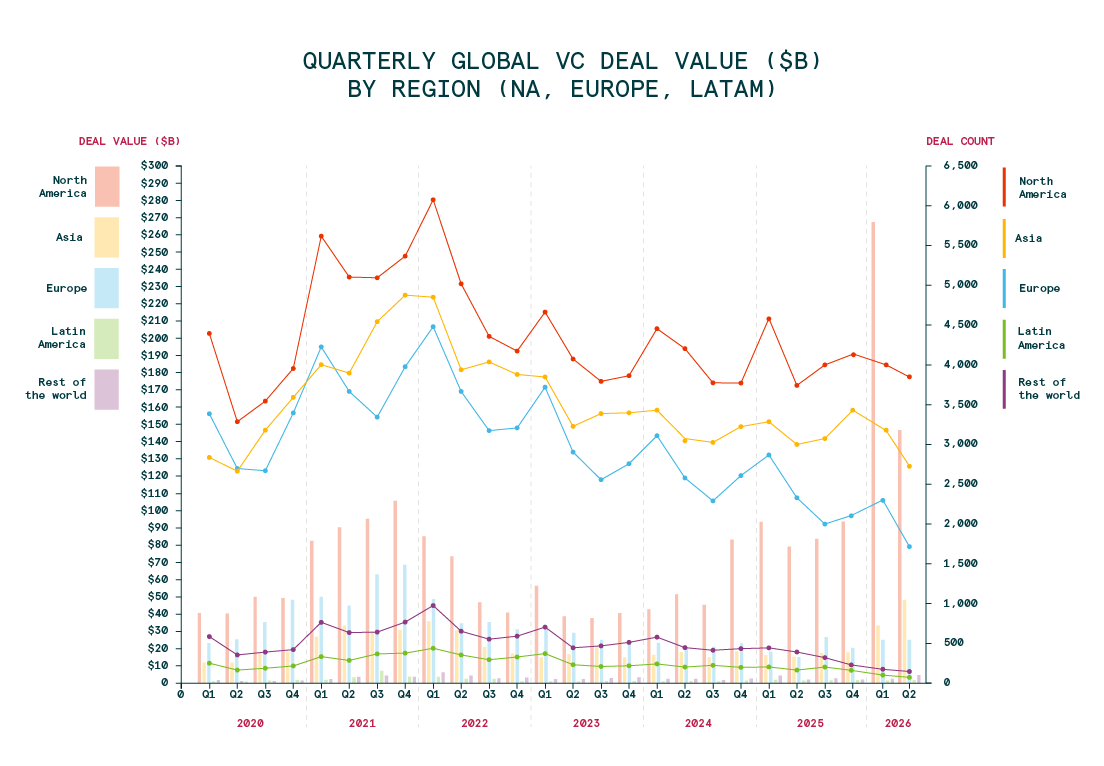
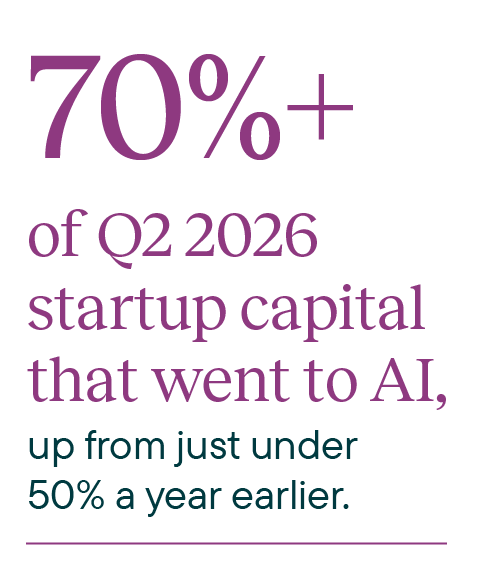
Q2 2026 extended the value/volume split from Q1, though the extremes softened. Global deal count fell to roughly 8,470, down 18% quarter over quarter and 16% year over year, continuing the shift toward fewer, larger checks. Total deal value came in at $227.5B, down 32% QoQ from Q1's $332.9B but still up 78% YoY from Q2 2025's $127.6B. North America's share of global deal value eased to 64%, down from 81% in Q1, as its frontier-lab megarounds cooled from Q1's peak while the rest of the world held its dollar totals roughly flat. The structural shift toward concentrated, AI-driven capital deployment continues, just with less extreme concentration than Q1's historic high.

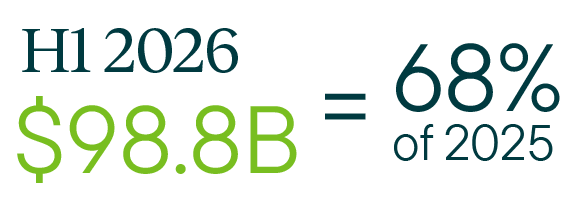
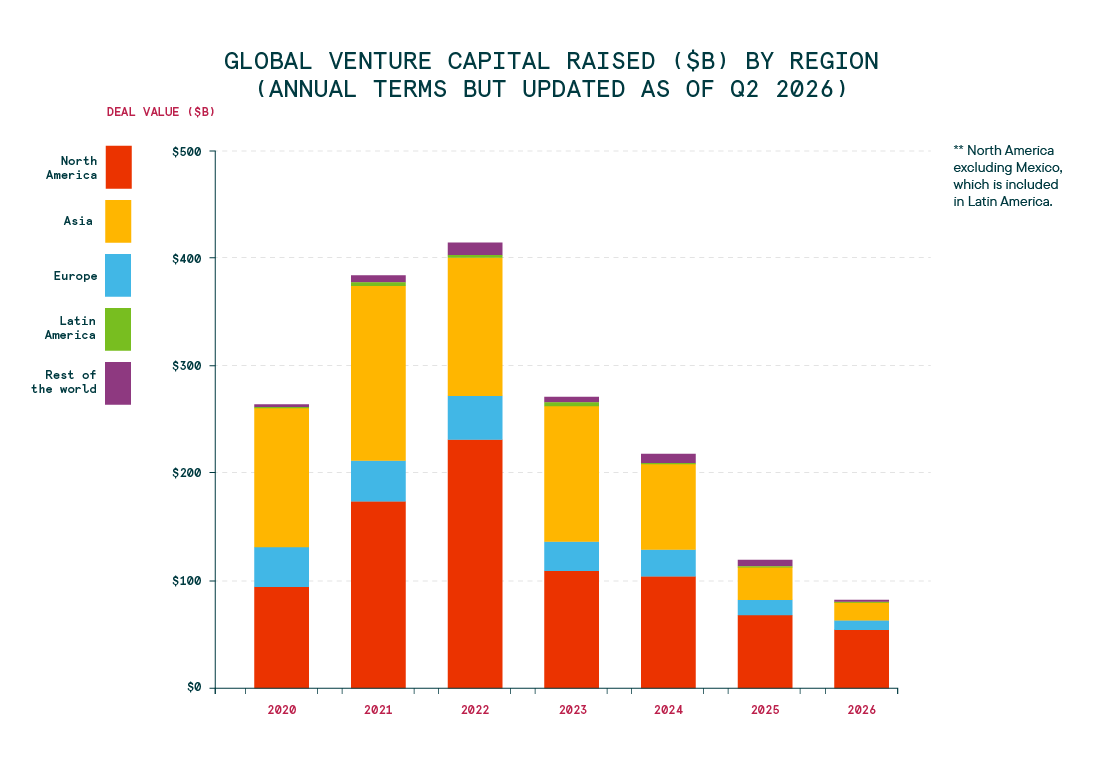
Fundraising's rebound accelerated in Q2. Global VC raised fell 36% in 2025 (from $229.2B in 2024 to $145.9B), extending the multi-year contraction flagged last quarter. But H1 2026 already shows $98.8B raised, 68% of the entire 2025 total in just two quarters, the strongest first-half pace since the 2021-22 peak. North America accounts for 74% of that total ($72.8B), so the rebound is still concentrated in a handful of large platforms rather than broad-based, consistent with what we flagged in Q1.

Exits went from a strong thaw in Q1 to an outlier-driven spike in Q2: global VC exit value jumped to roughly $1.9 trillion, up 339% QoQ, almost entirely on SpaceX's $1.77 trillion IPO and its ~$60B Anysphere (Cursor) acquisition. Strip SpaceX out and exit value is $138B, up 15% YoY but below Q1's pace. Exit count tells a steadier story: 775 deals, down 4% QoQ and 14% YoY.

Source:pitchbook
01
Biotech Momentum Returns with Selective Capital
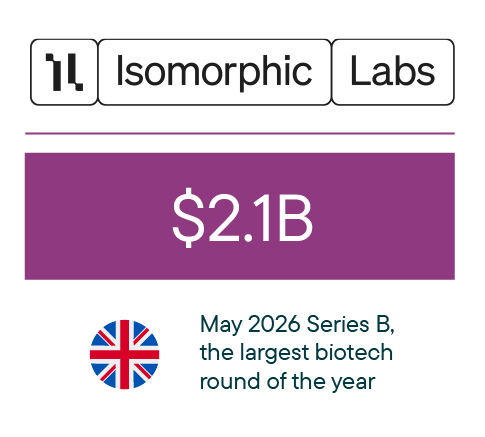
Biotech capital came back in Q2 2026 with more discipline than enthusiasm: fewer, larger checks from specialist funds and existing backers doubling down on de-risked, later-stage platforms, alongside new European fund closes. That thesis got a vote of confidence from the AI labs themselves, who moved from tool-builders to direct participants in life sciences, from M&A to shipping their own scientific products. We're very bullish on the space: between Reveri, Paloma Health, Harmony Baby Nutrition, Tiny Health and Senticell, we think we're at a pivotal moment for human health.


02
Sovereign Capital Is Building the AI Stack Directly
Governments and sovereign wealth funds moved from watching AI from the sidelines to owning a piece of it, and companies are following the same logic with their own data. The UK launched a dedicated public venture fund for homegrown AI, Gulf sovereign funds poured record capital into US and European AI infrastructure and frontier labs, and a coalition of banks and corporates started co-designing private AI models trained on their own data instead of handing it to outside vendors.
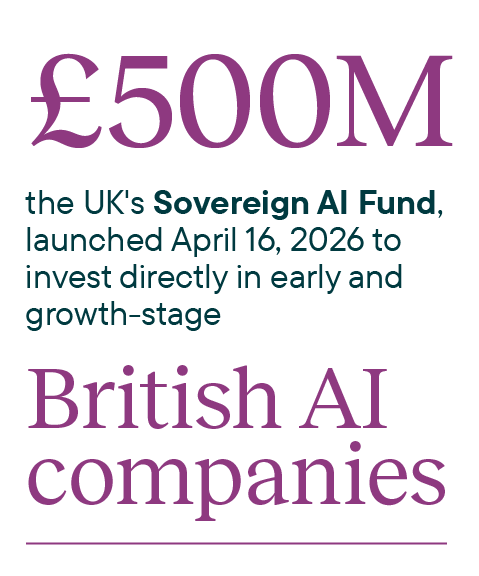
Source:UK Sovereign AI Fund
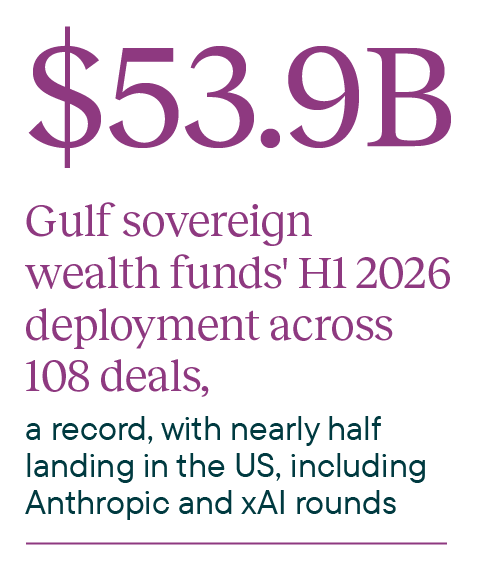
Source:Semafor, via Global SWF
03
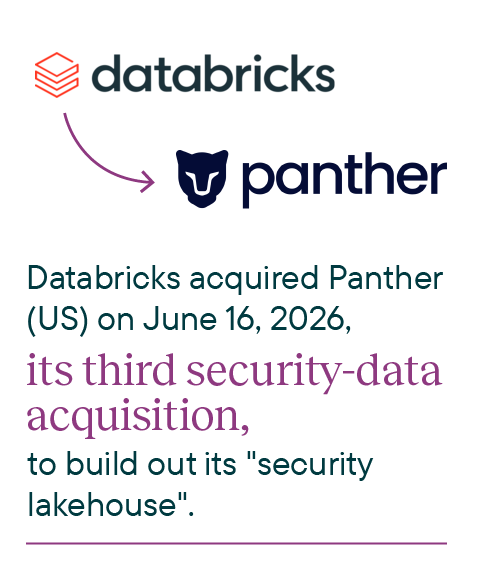
Buyers Are Hunting for Data, Not Models
As foundation models commoditize, company value is shifting from revenue multiples to who owns the data behind them. Incumbents have a real edge here, if they build their own models on that data or use third-party models on it while keeping control, they compound the advantage; those still treating data as an afterthought won't last.


04
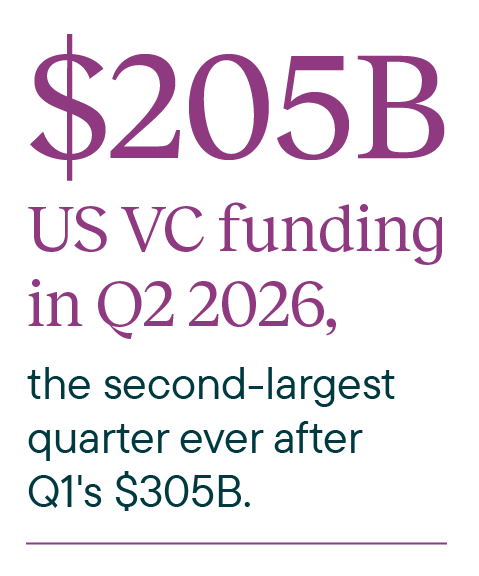
Venture Capital Keeps its Concentration Around AI's Biggest Bets
Q2 2026 venture data shows record aggregate funding masking a deeply bifurcated market, with capital concentrated in a small number of massive AI deals while the broader ecosystem stays disciplined. Early-stage VCs face a 'surgical' environment where quality and underwriting discipline matter more.

05
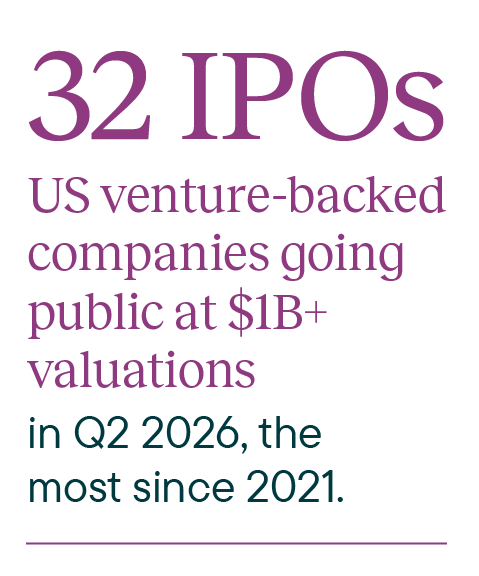
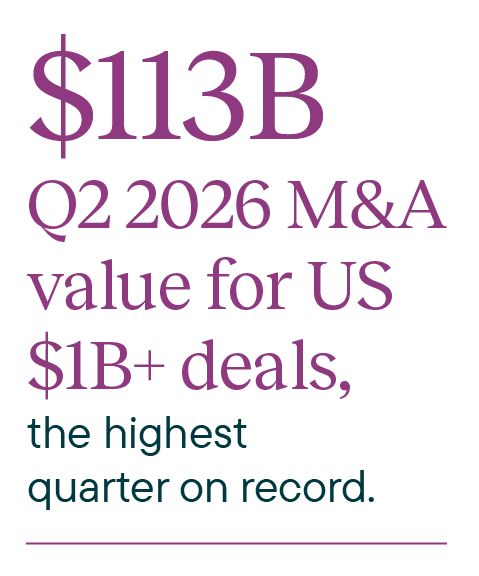
Exit Window Reopens with Mega-IPOs and M&A
Q2 2026 marked the most significant surge in billion-dollar liquidity events since the 2021 peak, with a wave of large IPOs and M&A transactions signaling a thawing, though concentrated, exit environment. For early-stage VCs, renewed liquidity enables portfolio recycling and strengthens DPI narratives with LPs, TVC included: Passport's sale to Global-e in May and Spike Technologies' acquisition in early July both delivered realized returns.

Looking ahead
Infrastructure Frontiers Draw Selective Capital
Exit Momentum Sharpens DPI Pressure on Funds
Data Moats Become the New Diligence Default

Ecosystem builder perspective

María Dancausa, product manager at TheVentureCity, describes our approach to building a GenAI product.


Rewind to this time last year, and the headlines were dark and ominous. They were ablaze with layoff news and economists fueling the fire with warnings of more turbulent times ahead. The questions on everyone’s mind: can the US pull off a soft landing while curbing inflation? How will quantitative tightening impact consumer spending? How will the technology ecosystem weather the storm?
A few things are clear in hindsight. In the public markets, investors enjoyed a strong end to the year, albeit after a bumpy start. The S&P ended 2023 at +24% and the tech-heavy Nasdaq at +43%. The magnificent seven, comprised of companies that already have some of the largest market cap, smashed it with a 111% YoY growth (Kiplinger). Within this power basket is NVIDIA, the stock everyone wishes they had bought in Q1 2023, which ended up an astonishing 239% over the full year of 2024 (Statista).
Last quarter we reported a brief opening of the IPO market. We remain confident that we will see more companies go public in the back half of 2024 and into 2025, and have noted hundreds of quality candidates detailed in CB Insights’ IPO pipeline of 250+ companies (CB Insights).
Bucking the downward B2C trend we mentioned earlier, Shopify, up 124% YoY, caught our attention. We have always leaned into the e-commerce enabler space, making notable investments such as in our very own Returnly, acquired by Affirm in 2021, so we are excited to see the momentum within this space.


